How to Scale AI Without Multiplying Systems of Record
Most product leaders scaling AI hit the same wall: more models, more agents, more dashboards, and less clarity about what is true. The failure mode is not weak intelligence. It is conflicting writes, duplicate automation, and eroded trust in the system of record.
I have applied the same decision-rights model at enterprise scale (13-product AI and data portfolio, 100+ markets, $8M budget, 60+ team) and reproduced it daily in a solo proof lab. This page is a one-page operating brief for leaders evaluating governed multi-agent ops, not a tool review.
Executive recommendation
One owner per workflow’s system of record. Separate identity, execution, and audit. Scale by registering agents and automations, not by adding parallel brains.
In my live proof lab, that maps to a Knowledge Base for registry and identity, an Agent Orchestration Layer for interactive and scheduled work, and a read-only audit layer.
Enterprise translation
| Enterprise concern | What leaders worry about | How this model addresses it |
|---|---|---|
| Portfolio sprawl | Every team launched its own AI initiative | One task registry; one Active Writer per task |
| Compliance / legal | AI touching regulated data | Audit layer reports; does not silently remediate |
| Platform ownership | Who owns CRM sync, brief, audit trail? | Explicit write authority per workflow |
| Transformation fatigue | Another tool rollout | Operating model change before tooling expansion |
| Evidence | Did the agent actually run? | Runs, handoffs, evidence trail |
The pattern is portable whether the registry is a Knowledge Base, Salesforce, or an internal CMDB, and whether execution runs on an Agent Orchestration Layer, an internal agent platform, or iPaaS.
Operating principles
| Principle | Meaning |
|---|---|
| One system of record per workflow | One runtime mutates each task’s system of record; others skip. |
| Registry outlives any single tool | Agent identity stays durable across chat windows and vendor changes. |
| Compliance observes; it does not quietly fix | Shadow audit reports failures; no silent repair. |
| Name integration constraints explicitly | Registered integrations are named; no fake clean topology. |
| Leaders decide what becomes true | Agents produce options; judgment picks what is true. |
Separation of concerns
1. Human judgment and escalation
2. Identity and authority: registry, decisions, evidence
3. Execution hosts: scheduled and interactive
4. Versioned procedures: skills, playbooks, automation definitions
Live proof lab
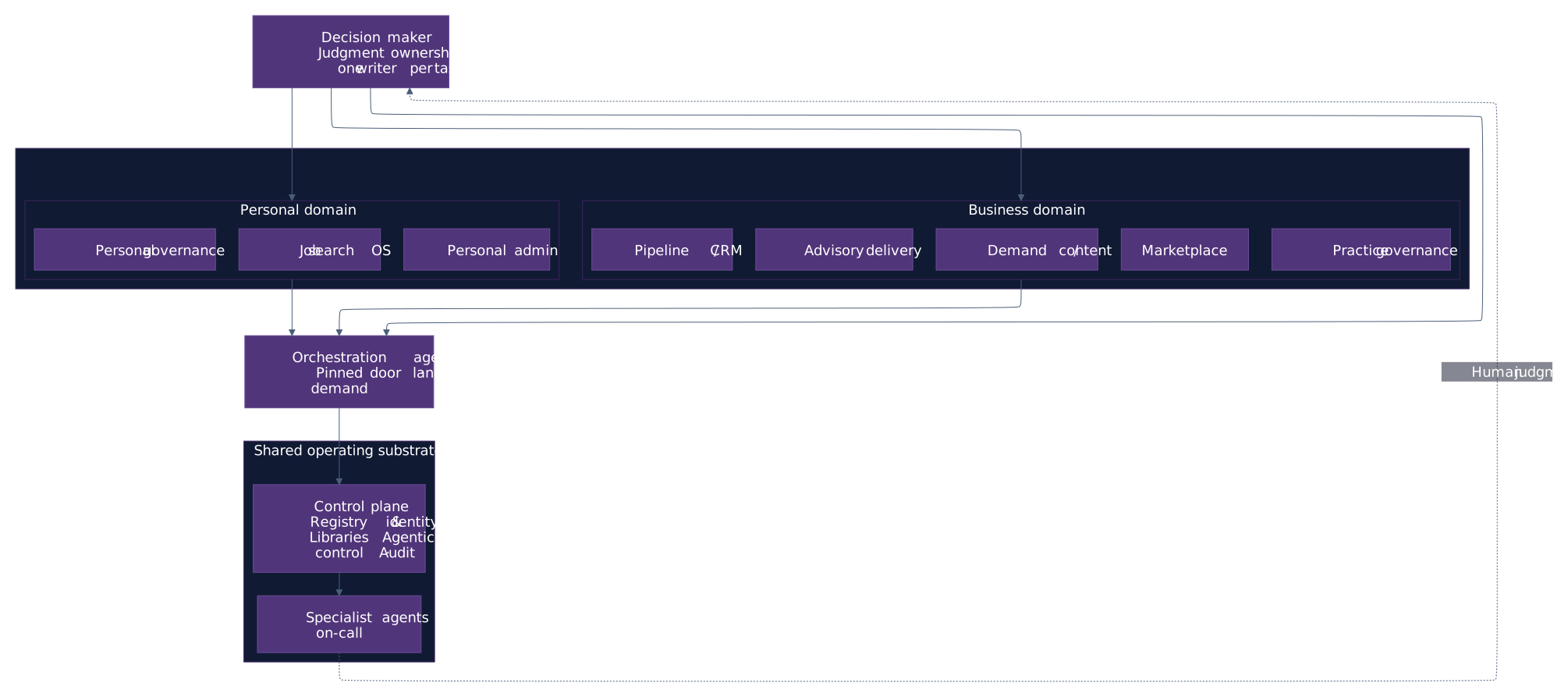
1. Human judgment and escalation
   ├─ Decision maker · interactive ops surface
   ├─ Orchestration agent
   └─ Control panel · deep drill

2a. Registry & identity
    ├─ Decision Log / Operating Spec
    ├─ Agent Registry + Agent Task Registry
    └─ Agent Runs / Handoffs · evidence trail

2b. Agentic control layer and audit layer
    ├─ Agent Orchestration Layer · preferred schedule host
    ├─ Audit layer · read-only verification and render
    └─ Registered integrations · named integration boundary

3. Versioned procedures
   └─ Skills library · versioned playbooks
Proof-lab scale: 32 skills, 39 governed automations on the Agent Orchestration Layer, 49 scheduled tasks.
Public architecture
Judgment stays human. The system carries the work.
What this proves
- Enterprise: 13-product AI/data portfolio, 100+ markets, $8M budget, 60+ team. Same class of problem as “every team bought an AI tool.”
- Solo proof lab: Morning brief, registry, and governance audit cycle run daily so the model is operational, not theoretical.
- Meta-proof: Job Search OS applies the same governance to my own career pipeline.
The same decision-rights model holds whether the registry is a Knowledge Base or Salesforce and whether execution runs on an Agent Orchestration Layer or an internal agent platform.
What I would do in your environment
- Inventory tasks and systems of record, not models.
- Assign one Active Writer per task; stop duplicate writers.
- Stand up registry and evidence before expanding model access.